
The surprising history of EMS
What if we told you that the technology behind EMS training was once developed for astronauts and top athletes? Chances are you’d never look at an EMS suit the same way again. What is known today as an innovative and accessible way to get fitter, actually has an impressive history that began in the medical world and space travel. We’ll take you back to the origins of Electro Muscle Stimulation, and show you why this is not a hype, but a method with decades of proven results.
What is EMS and why is it so special?
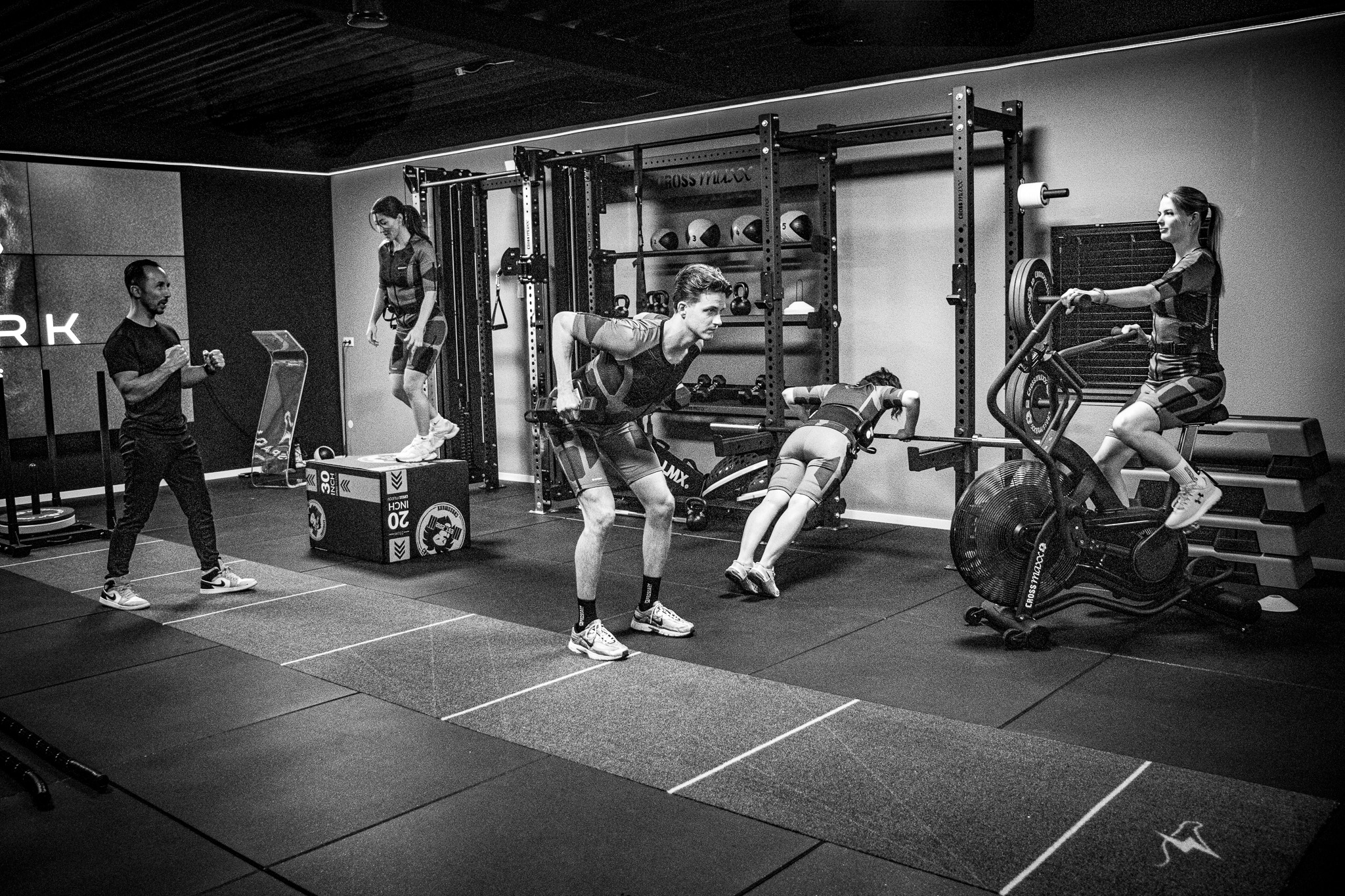
EMS stands for Electro Muscle Stimulation. The principle is relatively simple: controlled electrical impulses stimulate your muscles to contract. These impulses mimic the natural signal from your nervous system, making the muscles work extra hard. The special thing is that this not only activates superficial muscles, but also deeper muscle fibers that are difficult to reach with traditional training. When you combine EMS with targeted movements, it creates a workout that activates up to 90% of your muscle fibers. That’s what makes EMS so effective. But this technique didn’t just appear out of nowhere – its origins trace back to medical applications and space research.
The first applications in the medical world
In the 1960s and 1970s, doctors and physical therapists already used forms of electrical stimulation to help patients recover. Muscle weakness after surgery, paralysis due to injury or prolonged illness, and combating atrophy (muscle breakdown) were important reasons to use EMS. By placing electrodes on specific parts of the body, muscles that the patient could barely or not at all use themselves could be activated. This helped preserve muscle mass, which was crucial for recovery. These early applications proved that EMS was safe and truly effective. For patients, this meant enormous progress: where muscles would normally slowly deteriorate, they could now be actively stimulated and kept stronger.
NASA and space travel: an unexpected breakthrough
One of the most remarkable chapters in the history of EMS comes from space travel. Astronauts who spent extended periods in a zero-gravity environment faced a major problem: muscle mass and bone density rapidly decreased. Without the load of gravity, muscles and joints weakened, making return to Earth risky. NASA investigated various ways to counteract this and turned to EMS. With electrical stimulation, astronauts’ muscles could be activated without them having to lift heavy weights. This offered a solution for the unique conditions in space. EMS thus literally became a space technology and proved effective even in the most extreme situations.
From sports science to elite sports
Parallel to these medical and scientific developments, sports scientists also began to take an interest in EMS. Especially in Eastern Europe, where innovative training methods had been experimented with for a longer time, EMS was used by elite athletes. In countries like Germany and Russia, coaches saw how EMS helped athletes get stronger, recover faster, and prevent injuries. The electrical stimulation proved to be a valuable addition to traditional strength training. By activating muscle groups that are normally difficult to reach, athletes could elevate their performance to a higher level. Consider, for example, sprinters who wanted to increase their explosiveness or weightlifters who wanted to better train their stabilizing muscles. EMS quickly became a secret weapon in elite sports.
The transition to consumer fitness
While EMS was initially primarily applied in laboratories and clinics, the technology began to become more accessible to consumers around the 2000s. EMS suits became more modern, portable, and comfortable. Where large devices were once needed, compact systems emerged that could be used in fitness studios. This allowed even people without medical indications to benefit from the advantages. Especially busy professionals discovered the power of EMS: a workout of just 20 minutes yielded the same results as a traditional hour in the gym. That made EMS attractive to anyone who had little time but wanted results.
EMS today: accessible and proven effective
Today, EMS is available worldwide. Studios cater to various target groups: from people who want to lose weight or get fitter to athletes seeking extra performance. Additionally, EMS remains valuable in the medical world, for example, in rehabilitation or for back pain. What makes EMS unique is that the method has been scientifically researched for decades and has proven its effectiveness time and again. It is not a hype that coincidentally became popular, but a technology that has proven itself in various fields – from hospitals to space travel.
Why history matters
By understanding the origin and development of EMS, it becomes clear why this form of training holds so much value. It’s not just a gadget or a fitness fad. It is a technology that began in medical science, proved itself in space travel, and demonstrated its value in elite sports. Today, we can experience those same benefits in an accessible and enjoyable setting.
Do you want to experience it?
Do you want to experience what it’s like to train with the same technology as astronauts and elite athletes? At Spark Sessions in Nuenen, we offer you the chance to experience this for yourself. Book a trial training and discover why EMS is the perfect combination of science, effectiveness, and results.